
Karol Kurpiński
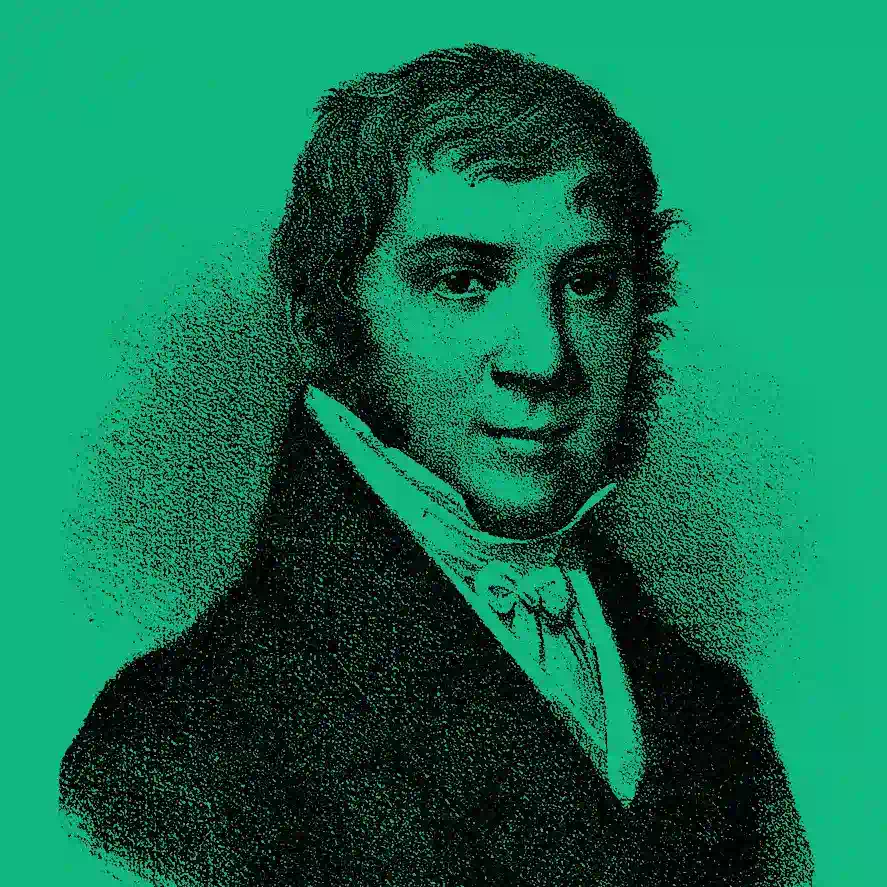

Biography
's Life in Key Moments
Follow the composer’s artistic journey.
From his early years to his triumph on the Warsaw stage, every stage shaped his legacy.
“Karol Kurpiński (1785–1857). Life and Work”
by Fr. Tadeusz Przybylski
INTRODUCTION
The life and work of Karol Kurpiński, one of the leading figures of Polish musical culture in the pre-Chopin era, have not yet been sufficiently studied, although the broad outlines of Kurpiński’s artistic career have been generally known for over 100 years. However, this information has contributed nothing new not only to his biography but also to his great creative achievements and diverse activities in support of Polish cultural life during the difficult period of Russian partition. The purpose of this publication, therefore, is to present his diverse activities in the field of Polish social culture in the first half of the 19th century. The work is based on over twenty years of documentary research on this subject.
Józef Sikorki, a leading music critic in nineteenth-century Warsaw, wrote in an obituary in 1857 that Kurpiński “made great contributions in every branch of musical work, and for over thirty years his name was directly and indirectly associated with almost everything that happened in the world of music in our country. (...) Kurpiński’s musical life is a half-century of music history in our country.”
Indeed, Kurpiński’s musical activities were wide-ranging. They manifested themselves in his compositions for opera, orchestra, chamber music, piano, and voice (both solo and choral), encompassing both secular and religious works. Kurpiński also made significant contributions to music journalism and outreach, as he founded and edited the country’s first music magazine, “Tygodnik Muzyczny” (1820–1821), in which he published, among other things, numerous articles of his own that remain valuable not only historically but also substantively to this day.
As part of his teaching career, he trained a number of opera soloists. As a music theorist, he wrote several music textbooks that served as educational resources for young people studying music throughout nearly the entire 19th century. He also wrote two very important memoirs: Memoirs of a Journey in 1823 and A Brief History of the National Theater from 1818 to the Present, published anonymously during the November Uprising. In his organizational work, he restructured the National Theater, simultaneously modernizing its repertoire with contemporary European operas. He also served as director of the National Theater Opera.
J. Sikorski’s aforementioned opinion of Karol Kurpiński was accepted in its entirety and endorsed by historians and music writers in the 19th and 20th centuries. For example, the “father of Polish theater,” Wojciech Bogusławski (d. 1829), wrote in *The History of the National Theater* that “it will always be a source of pride for me that the founding of the Polish Opera (...) and the talent of Mr. Kurpiński, which brings honor to Poles, will remain part of my *Scena Ojczysta* administration until the end of my days.” The historian and ethnographer Łukasz Gołębiowski (d. 1849) noted that Bogusławski knew how to recognize Kurpiński’s talents. “The results of these talents soon became evident in the composer’s works, and subsequently in the precise organization of the orchestra and choirs, and in the vivid expression he brought to the principal vocal parts (...) thereby raising Polish opera to a higher level.”
The historian and journalist Ernest Sulimczyk-Świeżawski (d. 1919) wrote that Kurpiński “sought to fill all the gaps in our musical culture. (...) The first music magazine he founded also served to spark musical interest. If only that had been his achievement (...) he would already be worthy of a monument to our gratitude in the history of our music.” In turn, composer Zygmunt Noskowski (d. 1909) noted in one of his press publications: “Already in his first operas, Kurpiński significantly surpassed most of his predecessors both in terms of craftsmanship and compositional inventiveness, and at the same time in the skillful and creative use of folk elements.” It should be emphasized that this characterization of K. Kurpiński’s work, penned by this outstanding composer, conductor, and teacher of many composers, deserves special attention. For it influenced the views of subsequent music historians at the dawn of the 20th century. Thus, the musicologist, composer, and conductor Henryk Opieński (d. 1942) stated emphatically that Kurpiński’s music was “an important step on the path to the crystallization of a national operatic style.”
The musicologist Józef Reiss (d. 1956) in his popular and frequently reprinted comprehensive work *Polish Music Is the Most Beautiful of All*, concluded that Kurpiński “raised the Warsaw Opera to new heights and kept it in constant contact with Western European opera.”
Alina Nowak-Romanowicz (d. 1994), a researcher at the Institute of Musicology at the Jagiellonian University, music theorist, pianist, and author of a number of scholarly works primarily on Polish musical culture of the Enlightenment and early Romanticism, wrote in *History of Polish Music. Classicism 1750–1830, she wrote in a memorable way that Elsner and Kurpiński made the greatest contributions to the development of Polish opera. They are the creators of opera in the national spirit, and Moniuszko became their perfect successor in this field.”
LIFE
Karol Kurpiński was born in the village of Włoszakowice, about 20 km from Leszno in Greater Poland, in March 1785, the son of the local organist Marcin and Franciszka, who came from the Wański family of musicians in Greater Poland. He was baptized on March 6 of that year in the local church as Karol Kazimierz.
From early childhood, he displayed exceptional musical talent and interests. His father’s profession undoubtedly amplified these interests, leading to the fact that at the age of 12, equipped by his father with what was necessarily still modest knowledge and skills in this field, he took up the position of organist in 1797 in nearby Sarnowa near Rawicz, where his mother’s brother, Rev. Karol Wański, was the parish priest. From then on, he gained musical experience on his own as an organist, developing his innate musical abilities.
When the professional musicians Jan and Roch Wański visited their brother, Father Karol Wański, in 1799, their joint performance in the church choir completely fascinated and captivated the young Karol Kurpiński, to the point that he no longer wished to be an organist. Their performance prompted him to reflect sadly on himself, his current musical abilities, and his future prospects upon returning to Włoszakowice. He therefore made an earnest plea to his relative Roch Wański, who was a cellist in Count Feliks Polanowski’s palace orchestra in Moszków near the town of Sokal (today in Ukraine), to take him along and place him in that orchestra.
In 1800, he joined the orchestra as second violinist. Although he possessed a rich melodic imagination and undeniable compositional talent, he saw no realistic chance of further acquiring the musical knowledge he so desired through regular, formal instruction in the discipline. Given the circumstances, he undertook to acquire it through self-education. From then on, his sole school became the systematic, persistent, and intense study of the scores of orchestral works by Haydn, Mozart, and other masters, which were found in great numbers in the library of the palace in Moszków. It was thus solely through this path that this brilliant self-taught musician mastered the secrets of compositional technique, which was later so highly regarded by music experts and critics.
Following the death of Feliks Polanowski and the dissolution of his orchestra in 1808, Kurpiński moved to Lviv, where he taught piano to the children and young people of the city’s wealthier bourgeoisie. However, still seeing no opportunities for his further musical development or for putting his acquired musical skills to use, he went to Warsaw in 1810, where, thanks to a fortunate coincidence, the 25-year-old Kurpiński was introduced to the director of the National Theater on Krasiński Square, the “father of the Polish stage,” Wojciech Bogusławski, who hired him on July 1, 1810, as the second conductor of the theater orchestra alongside Józef Elsner, its principal conductor.
Kurpiński possessed a remarkable technical skill for his time, which, combined with his compositional ingenuity, enabled him to create a wide range of musical works, among which his operatic compositions stand out. Kurpiński made his debut as an opera conductor on August 1, 1810, at the opening of the new opera season, and as a composer on December 4, 1810, with a cantata in honor of Napoleon. The following year, he composed and staged his first three stage works (Two Huts, Lucifer’s Palace, The Siege of Gdańsk). The years 1815–1823 were a particularly creative period in his life, as during this time he wrote the music for over a dozen stage works, including four ballets. (A list of these works is provided at the end of the book).
Like many prominent figures of that era, Kurpiński was a member of the Freemasons from 1811, reaching the penultimate degree of initiation. In 1815, he became a member of the Warsaw Royal Society of Friends of Science. From 1812, he taught at the Drama School at the National Theater, and from 1817 at the Elementary School of Music and Dramatic Art.
In April 1815, Kurpiński married Zofia Brzowska (1800–1879), a young actress at the National Theater and a student of Bogusławski, who initially performed only in dramatic roles. Over time, thanks to her own hard work and her husband’s support, she was also able to perform successfully in operas.
She performed on stage until 1842. The Kurpińskis had no children.
His growing reputation as a composer and his contributions to court ceremonies with his music led Tsar Alexander I to appoint him court bandmaster in 1819 and to award him the Order of St. Stanislaus in 1823.
From March to December 1823, Kurpiński undertook a nine-month educational tour of the theaters of Western Europe on a government scholarship (he visited, among other places, Dresden, Leipzig, Paris, Milan, Florence, Rome, Naples, and Venice), which was intended to prepare him to independently lead the National Theater’s Opera.
On July 1, 1824, Kurpiński became the sole conductor of the National Theater and, consequently, the director of the Warsaw opera house. He held this position for 16 years, until 1840. On February 24, 1833, with Gioacchino Rossini’s The Barber of Seville, he inaugurated the Grand Theater on Teatralny Square as the new home of the National Opera (today it is the Grand Theater–National Opera).
During the November Uprising, Kurpiński staged several operas with patriotic themes and composed eight songs of the uprising, including “Warszawianka” (“Today Is a Day of Blood and Glory”), which was widely regarded at the time as the national anthem.
Due to the constant intrigues of a jealous musical community and ongoing disputes with the theater’s management over operational autonomy, regarding the repertoire and the Polish character of the stage, in 1840 he resigned at the age of 55 and, bid farewell by the opera staff at a solemn ceremony, took early retirement.
Kurpiński spent his final years in solitude, yet closely following the musical life of Warsaw at the time. Kurpiński’s last composition was a Requiem for three male voices, organ, and trombone, begun on November 2, 1847, and left unfinished.
He died in Warsaw at his home on Żelazna Street on September 18, 1857, at the age of 72, after suffering from throat tuberculosis. He was given a grand funeral and was buried at Warsaw’s Powązki Cemetery. A year after his death, a monument was erected on his grave using public donations, and it still stands today.
Theatrical works
Karol Kurpiński’s operatic output consists of 24 operas and 4 ballets. Within his overall body of work, this genre occupies a central position. These works, composed in the first quarter of the 19th century, have survived to this day in the following condition, despite the country’s numerous political setbacks and the resulting destruction: 9 operas have survived in their entirety, and another 9 have survived in fragments, mainly in the form of opera overtures, which are, in fact, their most valuable parts. It must also be noted that no score of any of his operas was published at the time. Only Stanisław Moniuszko was fortunate enough to have his works published during his lifetime. However, during Kurpiński’s lifetime, several scores of overtures from his operas, as well as several arias and songs in piano arrangements, were published in Leipzig. Of Kurpiński’s four ballets, three revolved around the then-fashionable classical-mythological-allegorical theme. One has been lost, and two have survived only in fragments. Only the ballet The Krakow Wedding in Ojców has survived in a piano arrangement. This first Polish ballet after World War II was arranged for orchestra by Tomasz Kiesewetter.
As for Kurpiński’s operas, it can already be tentatively concluded that they serve as a bridge between Polish opera of the Stanisław era and Moniuszko’s *Halka*. For there is such a vast gap between Maciej Kamieński’s Nędza uszczęśliwiona—considered until 2005 to be the first Polish opera, staged in Warsaw in 1778—and Moniuszko’s work that only Kurpiński can bridge it with his own operatic output. In this period, however, the operatic works of Jan Stefani stand out, particularly Cud mniemany, czyli Krakowiacy i Górale (1794). This work concludes the first, sixteen-year period in the history of our opera, which marked the beginning of the development of Polish national opera. After 1795, Józef Elsner took up creative activity in this field, and from 1811 onward, it was Karol Kurpiński, who from the very beginning set himself apart from his predecessors, both in terms of compositional inventiveness and the quality of his compositional craftsmanship, and, in relation to Enlightenment operas, also in terms of the degree to which they were infused with folkloric elements. For Kurpiński, as Zygmunt Noskowski, already cited, noted, the problem of national style was always a central issue in compositional technique and artistic ideology.
Kurpiński’s creative talent was beyond dispute from the very beginning of his career as a composer. Even his contemporaries were aware of this. In 1818, for example, the press wrote: “We are delighted that [Kurpiński] gives us hope of having our own music.” And in 1819, the public honored him with a letter of commendation signed by prominent figures of the time and a commemorative gold medal struck in the composer’s honor, featuring his bust and the inscription: “For beautiful works of harmony, fellow countrymen.” By then, Kurpiński had already composed music for 19 stage works. No wonder, then, that the public rejoiced in such a prolific and outstanding composer, having already dubbed him “the firstborn son of Sarmatian Euterpe.” He was, in fact, widely regarded as the national composer.
At this point, it is necessary to clarify the concept of opera as it was understood in Poland at the time. I use the term “opera” in reference to theatrical and dramatic works in its broadest sense, that is, to denote any dramatic work that includes musical passages. The typology of the genre depends on the chosen classification criterion, which may be the textual layer—i.e., the subject matter of the libretto—or the musical layer—i.e., the function and form of the music in a given work. From this latter perspective, one can distinguish between a fully composed opera, which in the period under discussion is encountered only sporadically in Poland, and a type of opera in which spoken scenes alternate with sung scenes. All of Kurpiński’s operatic works belong to the latter category. This type of opera is divided into several subgenres, such as melodrama, commedia opera, and comic opera.
The melodrama, or “drama with music,” was characterized by mediocre literary merit, but its strength lay in its numerous stage effects, which were eagerly absorbed and appreciated by the simple bourgeois audience of the time. The music mostly accompanied recitations, though there were also solo and ensemble vocal parts. Comedia opera had similar aesthetic principles to those of the Enlightenment, drawing on the literary genre of comedy. The librettos were thus written in a light tone and structured in such a way that they could function without music. The spoken parts were usually written in prose, while the sung parts were in verse. The librettos addressed current political, social, or moral issues, which is why these works quickly became outdated. The musical component of a commedia opera usually consisted of an overture and several songs. Sometimes the music was taken from other operas; only the text was changed.
Comic opera, on the other hand, always featured original music that took precedence over the spoken scenes. The vocal parts were dominated by grand da capo arias, while the solo sections evolved into duets, trios, and quartets. It should be noted, however, that a single opera may contain elements characteristic of various operatic genres, both in the libretto and in the music. As already mentioned, in keeping with the style of the time, all of Kurpiński’s operas feature spoken sequences alongside the sung scenes.
Kurpiński’s comic operas include eight stage works: *Lucifer’s Palace* (1811), *Jadwiga, Queen of Poland, or the Union of Lithuania with the Crown* (1814), *The Emperor’s Favor* (1814), *Superstition, or the Cracovians and the Highlanders* (1816), The Charlatan, or The Resurrection of the Dead (1814), The Castle at Czorsztyn, or Bojomir and Wanda (1819), Zbigniew (1819), and Cecylia Piaseczyńska (1829). His comic operas include: Two Cottages (1811), Marcinowa from the Danube in Istanbul in the Seraglio (1812), The Forester in the Kozienice Forest (1821), Czaromysł, the Slavic Prince, or The Nymphs of Lake Gopło (1818), Jan Kochanowski in the Black Forest (1817). The melodramas include 11 plays: Pygmalion (1808), The Siege of Gdańsk (1811), The Ruins of Babylon, or Giafar and Zaida (1812), Agar in the Wilderness (1814), Alexander and Apelles (1815), Nadgroda, or The Resurrection of the Kingdom of Poland (1815), Hero and Leander (1816), The Little School of Fathers (1816), Grandfather and Grandson, or Two Centuries (1816), The Battery of One Soldier (1817), Kalmora, or the American Law of the Father (1821).
Based on their subject matter, Kurpiński’s operas can be divided into seven groups. The so-called “magical opera” is represented by *Lucifer’s Palace* and *Czaromysł*; the “exotic opera” by *Marcinowa from the Danube*, *The Ruins of Babylon*, and *Kalmora*; historical: Jadwiga, The Siege of Gdańsk, Jan Kochanowski, Zbigniew, Cecylia Piaseczyńska; social: The Charlatan, The Battery of One Soldier, The Forester in the Kozienice Forest, The Little School of Fathers, Grandfather and Grandson; occasional: The Emperor’s Grace, Nadgroda; rural: Two Huts, Superstition; from the ancient world: Pygmalion, Agar in the Wilderness, Alexander and Apelles, Hero and Leander.
It should also be noted that in the history of Polish opera, Kurpiński pioneered the historical opera with Jadwiga (1814). In turn, by introducing fantastical themes into the 1818 opera Czaromysł, he foreshadowed, as it were, the romantic opera on Polish soil.
Kurpiński attached great importance to the textual aspect of his operas, choosing as librettists writers widely regarded as highly accomplished. Among them were such luminaries of Warsaw’s literary scene at the time as: Kazimierz Brodziński (Kalmora), Ludwik Adam Dmuszewski (Alexander and Apelles, Nadgroda, The Little School of Fathers, Cecylia Piaseczyńska), Jan Nepomucen Kamiński (Superstition), Józef Wawrzyniec Krasiński (The Castle at Czorsztyn, The Forester in the Kozienice Forest), Julian Ursyn Niemcewicz (Jadwiga, Queen of Poland, Jan Kochanowski, Zbigniew), Ludwik Osiński (Grandfather and Grandson), Wojciech Pękalski (Marcinowa from the Danube), Alojzy Żółkowski (The Battery of One Soldier, Czaromysł, The Charlatan). He was equally meticulous in selecting translators for the foreign librettos of his operas. They included: Ludwik Adam Dmuszewski (Two Huts, The Siege of Gdańsk, The Emperor’s Favor), Remigiusz Ładowski (Agar in the Wilderness), Józef Pawłowski (The Ruins of Babylon), Stanisław Doliwa Starzyński (Hero and Leander), Kajetan Węgierski (Pygmalion), and Alojzy Żółkowski (Lucifer’s Palace).
In his operatic works, Kurpiński did not reach the heights of the classical masters, but he certainly charted a new course for the development of Polish opera. Drawing on folk melodies, he was able to create a distinctive style of musical folklore. It was not for nothing that Chopin admired the melodies of Kurpiński’s opera *Zabobon, czyli Krakowiacy i Górale* (*Superstition, or the Cracovians and the Highlanders*), improvising on them during his concerts. Stanisław Moniuszko also utilized certain melodic motifs from Kurpiński’s operatic works, such as the melody of “Olszynka” from the opera *Zamek na Czorsztynie* in *Halka*, in the beautiful aria of its heroine, Halka (“Jako od wichru krzew połamany”). Likewise, the mazurka from Kurpiński’s opera Cecylia Piase-[p. 17]ńska clearly foreshadows, in its character, the famous mazurka from Halka. And when Moniuszko, in the prologue to The Haunted Manor, wishes to remind the audience of the nation’s glorious past in Maciej’s aria (“Farewell, our dearest companions”), he uses the song “Michał Korybut Wiśniowiecki” from Kurpiński’s Historical Songs. Such examples could be multiplied.
Zygmunt Noskowski, whom we have already mentioned, spoke highly of Kurpiński’s skills as an opera composer, stating that the value of his works in terms of form was “high for those times, for we find everything logically developed, carefully crafted, and well-rounded; we even frequently encounter in many passages [of the operas] contrapuntal phrases that are most felicitous and demonstrate a high level of expertise in this field. In addition, Kurpiński often sought to create engaging chord combinations and unusual harmonic progressions, which was commendable given the era, in which little attention was paid to this aspect of music in our country. (...) The orchestration is always exemplary, unfolding in a rich and varied palette. (...) Kurpiński’s operas, including this one, have the advantage that they usually feature good prosody, in which he far surpassed all his predecessors.” Thus, without hesitation, Noskowski staged the then-forgotten Jadwiga, Queen of Poland at the Warsaw Opera in 1907.
Adam Poliński, author of the first book on the history of Polish music (published in 1907), offered a similarly positive assessment of Kurpiński’s technical skills and talent in the realm of opera: “He lacked dramatic power, but the lyrical element—especially the comic one—was more in keeping with his particular talent.” Kurpiński’s clear and transparent orchestration, his sometimes interesting harmonic turns, and his original contrapuntal ideas eloquently attest to the high talent of this composer, who has rendered great service to Polish music.”
When assessing the public reception of Kurpiński’s operatic works, primarily based on press reviews from the first half of the 19th century, one must take into account the fact that at that time little was written about the music of the staged opera itself, as the libretto text and the stage action took center stage. Thus, when watching an opera, the audience primarily absorbed the librettist’s text and the depicted action, while the music served a secondary function in the viewer’s perception. Hence, in reviews from this [p. 18] period, only a few words were devoted to the music itself. There were also no music critics in Poland at the time. This role was filled only by literati with an ear for music, who generally lacked formal musical training.
Kurpiński’s first opera, *Dwie chatki* (*Two Cottages*), was staged at the National Theater in Warsaw in 1811, as were all his subsequent operas. Kurpiński awaited the review with understandable anxiety. The reaction of both the audience and the critics was very flattering to the 26-year-old composer. The *Gazeta Warszawska* wrote: “It must be fairly acknowledged that Mr. Kurpiński demonstrated in the music composed for this work an extraordinary talent and a truly Italian taste. That is why both music connoisseurs and the young audience rewarded him with thunderous applause during the performance and with the praise he deserved at the end.” This operatic compositional debut encouraged Kurpiński to continue his creative work in this field, and it aroused interest in Warsaw society in the creative talent of a composer hailing from the little-known village of Włoszakowice. And the phrase “in the Italian style” was, according to the contemporary conventions of musical beauty, a high compliment.
Kurpiński achieved a tremendous success as a composer with his second opera: the four-act *Lucifer’s Palace*. “The thunderous applause from the assembled audience during the performance and after its conclusion revealed the satisfaction this beautiful work by the young artist had brought them. He deserved it; he is worthy of praise and encouragement. (...) Let him only continue in his chosen profession, and he will earn the fame of a talented artist and bring honor to the National Theater.” After its next performance, it was written: “The music of this opera attracts a large audience every time, which is a great reward for its author and a merit in itself.” The Saxon Elector Frederick Augustus, who was present at the performance, took an interest in the opera, and wishing to stage it in Dresden, he ordered the score to be transcribed, rewarding the composer with a diamond ring. The music of this opera also found favor with Carl Maria von Weber, who expressed his favorable opinions about it.
The next four operas (*The Siege of Gdańsk*, *The Ruins of Babylon*, *Marcinowa from the Danube in the Seraglio in Istanbul*, and *Agar in the Wilderness*) were weak and did not bring Kurpiński success. In contrast, Kurpiński’s two-act comic opera The Charlatan, staged in 1814, gained great popularity. The music for it was received very positively. After its premiere, the press wrote: “After the performance, Mr. Kurpiński was called back on stage and showered with well-deserved applause. (...) The praise that spurred Kurpiński to work, which he received for this new work, is entirely justified, and friends of the Polish stage can expect much, very much, from him.”
Kurpiński’s next opera, the three-act *Jadwiga, Queen of Poland*, or The Union of Lithuania with the Crown, based on a libretto by Julian Ursyn Niemcewicz, was a great success, receiving an enthusiastic reception and becoming a major event in Warsaw’s theatrical life, particularly in light of Tsar Alexander I’s political plan to unite Lithuania with Poland under his rule. “The music of this play,” it was written, “should interest Poles just as much as the poetry, for it is the work of a fellow countryman. (...) Music lovers will find in Jadwiga qualities that will catch the eye of even the greatest connoisseur (...)”. Kurpiński’s subsequent operas were also received with great interest by audiences, such as *Zabobon, czyli Krakowiacy i Górale* from 1816, Zamek na Czorsztynie from 1819, and his final opera, Cecylia Piaseczyńska, from 1829, which were evaluated very positively by music lovers of the time, though reviews of the music itself, as usual, contained few words.
The typology of Kurpiński’s operas presented above, both in terms of their musical and textual layers, demonstrates a full utilization of his broad creative possibilities. Meanwhile, reviews of Kurpiński’s operas, though sparse in content, provide sufficient insight into the highly positive opinions of their contemporary audiences. It was not for nothing that it was written about the composer in 1830 that “we can boldly call Mr. Kurpiński the Polish Rossini, and we should take pride in having a national composer of beautiful and fresh [musical] imagination, just as other nations do. It is a pity, however, that we are unable to reward his outstanding talent. Let him, for the time being, be content with our thanks until time and circumstances reward him according to his merits (...)”.
Chamber music
Chamber music derives its name from the places where it was performed in the past: not in churches or theaters, but in court chambers (from the Italian camera, meaning “chamber” or “room”). From the 18th century onward, chamber music was also performed in bourgeois salons. During the Classical period (1760–1820), chamber music diverged from the symphonic music emerging at that time, which was composed for large ensembles. Chamber music is, after all, always composed for an ensemble of instrumental soloists. While chamber music may not be as spectacular as opera or the symphony, it has found a permanent place in the concert scene, in everyday life, and in home music-making. It places high demands on both performers and audiences, requiring the former to demonstrate great precision in performance, and the latter to possess not only a keen ear and sensitivity but also a high level of musical culture.
In today's understanding, chamber music refers to compositions written for a small number of instruments (from 2 to 9) in a single ensemble. Depending on the type of instruments performing a given piece, the ensemble is given a name such as a string quartet, a wind quintet, etc.
In Poland, the origins of chamber music date back to the 18th century. However, the forms in which chamber music appeared in the works of Haydn or Mozart did not emerge in Poland until the end of the Stanisław period (1764–1795). It was composed by such figures as Feliks Janiewicz (d. 1848) and Wojciech Dankowski (d. after 1836). One of the first Polish composers of string quartets was Maciej Radziwiłł (d. 1800). At the turn of the 18th and 19th centuries, three main centers of chamber music activity can be identified in Poland. These were the magnate estates, monasteries, and bourgeois circles of the time. Warsaw was the leading center for the development of chamber music at that time. It was there that musical societies were formed, which, through their concert activities, also contributed significantly to the development of chamber music.
An atmosphere of serious musical pursuit also prevailed at the court of County Governor Feliks Polanowski in Moszków, where Kurpiński resided for eight years beginning around 1800. Polanowski’s library was filled with quartets and various chamber music works. Both his direct exposure to this music and his performance and personal analysis of these works from the perspective of their compositional structure were very helpful to him in acquiring the necessary compositional skills.
As is well known, vocal forms—songs, operas, and cantatas—were the focus of Karol Kurpiński’s compositional output. Nevertheless, he also composed chamber music. In total, he wrote five works in this genre. These are: a miniature for clavichord (piano) and violin, *Reflections at Wanda’s Grave*; a Fantasy for French horn and bassoon; a Fantasy for string quartet; a Nocturne for French horn, bassoon, and viola; and a *Musical Landscape* for bassoon and French horn.
The first of these compositions, a miniature for violin titled *Reflections at Wanda’s Grave*, was published in 1820 as a sheet music supplement to *Tygodnik Muzyczny* (Music Weekly), Poland’s first music magazine, founded by Kurpiński. “Tygodnik Muzyczny.” It is a short, one-movement piece in which the violin carries the calm melodic line (in contrast to the lively accompaniment part played by the clavichord). Kurpiński’s aesthetic approach here is similar to that of the early Romantics. In this piece, the composer emphasizes a general, reflective mood of contemplation.
Nothing can be said about the Fantasy for Horn and Bassoon, as the piece has been lost. The only information available about it comes from a report in the *Kurier Warszawski* of the time, which states that the composition was first performed in Warsaw in 1821.
Kurpiński, however, adopted a different aesthetic approach in his Fantasy for String Quartet, which also bears the French title *Fantaisie en quatuor* and was composed around 1823. Although Kurpiński based this work on compositional techniques developed by the classics, he nevertheless attempted new solutions in this piece, both in terms of structure and the means of expression employed. Kurpiński signaled the distinctiveness of this composition already in its title (Fantasy). The point is that, contrary to conventional patterns, not a single movement of the work—and there are four of them—adheres to the standard musical form used at the time, namely the so-called sonata form. In short, it is a composition based on the freedom of improvisation.
Kurpiński also devoted considerable attention to both woodwind and brass instruments. In the scores of his various compositions, one can trace a series of attempts to give these instruments greater independence and individuality. This is evidenced by compositions for these instruments, such as the Clarinet Concerto, the Cavatina for Trumpet or Trombone with Orchestra, and other works. In these works, particularly the chamber pieces, Kurpiński demonstrated an excellent knowledge of these instruments.
In particular, the Concerto in B-flat major for Clarinet and Orchestra (premiered in Paris on August 10, 1823; Polish premiere in Warsaw on February 7, 1824) is in no way inferior in musical and artistic merit to the works of many contemporary composers. Moreover, in Polish music of the first half of the 19th century, it is the first and only work of its kind; further compositions for this instrument were not written until the second half of the 19th century.
The Nocturne for horn, bassoon, and viola consists of seven sections, four of which form a set of variations. Similarly, the Musical Landscape for horn and bassoon consists of seven sections, whose arrangement in this composition references the traditional serenade—a piece for a string and wind ensemble intended for evening performances outdoors.
It is worth noting that during the period when these chamber works were composed—around 1821— Kurpiński was significantly influenced by Beethoven’s music. This is evident not only from certain formal similarities (for example, in *Musical Landscape*), but also in the way the slow movements are dramatized within both of Kurpiński’s aforementioned cycles.
The four surviving chamber works listed above allow us to trace the composer’s efforts to move away from the established formal and structural conventions of contemporary chamber music toward new approaches that, aesthetically, pointed toward the emerging Early Romantic period, as is evident, for example, is the case in the aforementioned Fantasy. Kurpiński’s attempts to individualize wind instruments—which had hitherto played a rather marginal role in Poland—were also ahead of their time. These chamber compositions by Kurpiński must also have proved interesting to such a seasoned German publisher as was the Breitkopf & Härtl publishing house in Leipzig, since its owner purchased them from Kurpiński without hesitation in July 1823, paying 400 francs for them, as Kurpiński himself mentions in his Travel Diary.
Piano works
Although vocal-instrumental compositions dominate Kurpiński’s overall body of work, his piano compositions—despite not being among his most significant creative achievements—deserve attention in every respect, especially given that he authored five editions of a piano method.
Kurpiński’s piano works can generally be divided into two groups. The first consists of dance music, including polonaises, mazurkas, krakowiaks, and waltzes. The second group comprises non-dance forms: variations, fugues, and fantasies. The first group consists of only nine works. This number may seem surprising, given that Kurpiński composed over 20 polonaises alone to mark special occasions at Warsaw balls.
The point is that they were originally written for orchestra and only later "transposed for the clavichord." Hence, they often bear traces of orchestral texture, which is evident in the massiveness of the arrangement or in the character of certain technical figures, revealing their origin from various orchestral instruments. Therefore, in the author’s view, they do not represent a pianistic style in the strict sense of the word. The second group also consists of 9 compositions.
In the pre-Chopin period, dance forms played a significant role in the development of Polish music. At that time, a large number of polonaises, mazurkas, and waltzes were composed, as well as—though in much smaller numbers—minuets, anglaises, and contredanses. In this context, one can clearly observe the process of transforming a piece intended for dancing into a dance miniature. During this period, works were composed in parallel that were intended both for dancing and for listening, and it sometimes happened that a single piece served both of these functions.
The polonaise was the first form to undergo stylistic transformation. This process aimed to turn it into a melancholic and lyrical miniature. Kurpiński had already noted this distinction when he wrote in 1820: “Since Ogiński’s time, no one has written cheerful polonaises for dancing; they are all either sad or concert pieces, that is, meant for listening. But now, with the rebirth of our Kingdom, the style of the polonaise is once again characterized by a dignified gracefulness and the noble cheerfulness of old Poland.”
Indeed, the process of transforming the polonaise into a composition with a melancholic and sentimental mood—which began as early as the Stanisław era—reflected the general sentiments plaguing Polish society following its political defeat, as well as the sentimental and sentimentalist fashion prevailing in life and art — found its fullest expression in the polonaises of Michał Kleofas Ogiński. This style became representative of the polonaise of that era. Kurpiński also adopted it, with only minor variations, giving his polonaises a more heroic character.
Among the dance forms composed by Kurpiński, the polonaises—which he wrote most prolifically between 1818 and 1825—clearly take center stage. Hence, despite the reservations expressed, it is essential to include in the research process the piano transcriptions of so many of Kurpiński’s orchestral polonaises, especially since they were made by the composer himself.
It was in this form that they were widely enjoyed by the public, shaping the tastes and preferences of listeners, and likely serving as a model for both professional and amateur musicians alike.
In terms of formal structure, Kurpiński’s polonaises are based on the pattern commonly used for this type of dance at the time: an introduction followed by A+B (trio)+A. The lack of changes in the reprises made the composer’s work easier, but also made his creativity predictable. Despite this, Kurpiński, without altering the formal structure through additional artistic devices, imbued his polonaises with a deeper expressiveness, even though they were originally intended as dance pieces.
Kurpiński’s polonaises frequently feature motifs drawn from Polish folk music, always skillfully woven into the overall composition and supported by appropriate harmonies. The influence of vocal (operatic) music is also frequently noticeable. Together with the accompaniment, which takes into account the specific characteristics of the piano, this is undoubtedly a manifestation of stylization aimed at enhancing the aesthetic function of the piece.
Similarly, the use of thirds and sixths in the right-hand part—a feature frequently found in the composer’s polonaises—can be regarded as a stylistic device whose origins undoubtedly lie in Rossini’s operas.
The harmony in Kurpiński’s polonaises is generally simple and clear, though the composer does occasionally come up with more interesting harmonic ideas. Particularly noteworthy here are certain prolongations on the dominant that foreshadow the recapitulation, as well as the elegant crescendo at the organ point.
Kurpiński’s polonaises are, of course, based on homophony. He employed the technique of imitation in only one instance. Specifically, the polyphonically conceived theme in the Polonaise in A minor is echoed by an imitation a fifth above it. This technique had never before been encountered in the polonaise form.
Thanks to the counterpoint of the voices, this polonaise features interesting harmonies and serves as a good example of the composer’s deliberate efforts to aestheticize this dance form.
In Kurpiński’s polonaises, major keys predominate over minor ones. This is likely linked to Kurpiński’s aforementioned desire to imbue these dances with “old Polish noble cheerfulness.” One might see here a distant foreshadowing of that heroic character which, years later, Chopin would so magnificently portray, for example, in his Polonaise in A major, Op. 40 No. 1, or in A-flat major, Op. 53.
Kurpiński’s polonaises are not without their flaws, such as the repetition of the same motifs, the overuse of ascending and descending runs, the use of runs that are foreign to the rhythm of the polonaise, harmonic progressions that are sometimes banal, and monotonous rhythmic endings.
However, it must be acknowledged that, from a compositional standpoint, they differed greatly from the mass-produced, amateurish “output” of this dance form at the time. Kurpiński’s polonaises certainly played a role in the stylistic shift from the functional to the aesthetic, while also contributing to the overall process of crystallizing the Polish national style and paving the way for the music of the Romantics, particularly Chopin.
Like his polonaises, Kurpiński arranged five of his mazurkas for piano. They are characterized, among other things, by a shared key (D major), a similar phrasing structure, and even a similar phrasing pattern. The degree of stylization in the mazurkas is much less pronounced than in the polonaises, although they too contain elements of folk origin.
However, Kurpiński’s accompaniment for the left hand is not particularly well suited to this dance. The harmonica used by the composer in these dances essentially does not go beyond the triad. The rest of Kurpiński’s works in the dance genre do not merit serious attention.
Kurpiński’s second group of piano works consists of non-dance forms: variations, polyphonic pieces, and free-form works (fantasies).
In the first three decades of the 19th century, variations were a very popular form in Poland, practiced even by amateurs. They were composed either on original themes, or on themes drawn from operas, or on themes taken from popular or folk songs; and finally, also on themes of dances that were fashionable at the time.
It was precisely on the subject of this then-fashionable English dance that Kurpiński composed a set of six variations, published in Leipzig in 1813. A second set of variations was composed eight years later. It was published in 1821 as a musical supplement to the *Tygodnik Muzyczny* (Music Weekly), which he edited.
This cycle, consisting of a theme—the Ukrainian dumka—and nine piano variations, is far more mature than the previous one, both in terms of technical execution and artistic merit. In general terms, one could say that Kurpiński attempts here to move away from established classical patterns in the variation form in favor of loosening the structure of the cycle by introducing an element of improvisation.
In the pre-Chopin era, Polish composers did not often engage in polyphonic composition. “Here, this lofty form of music has few admirers,” Kurpiński remarked when writing about the fugue. Nevertheless, composers such as Franciszek Lessel and Ignacy Feliks Dobrzyński did compose them.
Sam Kurpiński composed two fugues, including one (in B-flat major) based on the theme of “Jeszcze Polska nie zginęła.” Overall, it must be said that the fugues of that period differed significantly from Baroque fugues. They lack structural precision, both in terms of form and in the technique of voice leading.
These works exhibit characteristics of the classical style, as evidenced, among other things, by the periodic structure of the theme, which, in the later sections of the fugue, undergoes a treatment similar to that found in sonata form rather than structural transformations; the transitional sections, meanwhile, feature a homophonic texture.
The works in which composers sought new means of expression most eagerly during the pre-Chopin period were the fantasias, as they were the least bound by conventional formal structures.
This form is represented in Kurpiński’s piano works by four compositions written between 1816 and 1823. In his fantasies, Kurpiński already employs techniques that we later find in Chopin, such as the use of a motif at the beginning of a composition that later serves as material for various elements of the entire work, or even the interplay of several (transformational and polyphonic in the form of imitation) within a single composition or cycle.
Secular songs
The origins of the Polish solo song with piano accompaniment—as a form that consciously combines poetry and music—can be traced back to the Polish Enlightenment. At that time, it took the form of the romance, created mainly by aristocratic amateurs, which typically consisted of French lyrics, while the music was in the spirit of Italian opera or French vaudeville.
It was not until the first three decades of the 19th century that the song entered a phase of intensive development in Polish music. The reason for this lay primarily in the deepening emotional subjectivity of the early Romantic era, which found in the song the best means of expression, and furthermore in the initiative undertaken by the Warsaw Royal Society of Friends of Science (active from 1800 to 1832).
In the early phase of the development of Polish solo songs with piano accompaniment, anthologies were popular; this trend was initiated by Józef Elsner in 1803–1805 with the publication of *A Selection of Beautiful Polish Musical Works and Songs*.
This form of subjective artistic expression, characteristic of the dawn of Romanticism, was also adopted by Karol Kurpiński, who on several occasions in his articles published in “Tygodnik Muzyczny,” expressed the view that vocal-instrumental music was superior to instrumental music, arguing that instrumental music conveys meaning to a much lesser extent than music combined with words.
It is therefore understandable that he devoted his creative work primarily to this particular form of composition. Although Kurpiński’s songs are of lesser artistic significance compared to his operatic works, they nonetheless occupy an important place within this genre of national music.
As a member of the aforementioned Society of Friends of the Sciences, Kurpiński became deeply involved in its ideological activities aimed at fostering and promoting Polish songwriting.
Between 1812 and 1835—that is, during the peak of Kurpiński’s creative output—he composed over 60 solo songs with piano accompaniment, including both secular and religious works.
This composer’s secular song repertoire encompasses all the major genres of the period: dumkas (6 songs in the collection *Historical Songs*, *Dumka*, *The Peasants of Jabłonna’s Duma about Their Lord*); ballads (Ludmiła in Ojców, Czerna); sentimental and love songs (Elfryda, Laura, Etwin and Klara, To Ludmiła).
The *Historical Songs* hold a unique place in Kurpiński’s entire vocal oeuvre due to their popularity and their social and educational significance. This cycle was commissioned by the aforementioned Society of Friends of Science, based on texts written by Julian Ursyn Niemcewicz.
The Historical Songs consist of 33 poems based on historical facts concerning the history of Poland. They were first published in Warsaw in early November 1816. Due to their popularity, the Songs were subsequently reprinted several times.
The lyrics of the poems were set to a melody, played with piano accompaniment, to make them easier to memorize. Several Polish composers, both men and women (including some amateurs), undertook this task out of patriotic motives.
Kurpiński set the following poems to music: Bolesław the Wry-mouthed, King Alexander, Sigismund Augustus, Władysław IV, Stefan Czarnecki, and Michał Korybut.
Historical songs played a major role in fostering patriotic awareness and providing aesthetic and musical education to listeners and performers alike, forming the core of the Polish song repertoire of that era. Stanisław Moniuszko described them as the first school of musical understanding, and the songs set to music by Kurpiński particularly stuck in his memory.
Echoes of the song about Michał Korybut can be heard, for example, in the final scene of the prologue to his *The Haunted Manor*.
The songs were essentially a rhyming history of Poland "with music and illustrations," rather than a collection of songs in the strict sense of the word.
Based on these principles, the composers of the *Śpiewy historyczne* created a unique musical genre, formally related to the solo song genre, yet so constrained by its didactic and patriotic purpose that, despite differences in talent and musical training among the individual composers, the cycle possesses a noticeably uniform style.
This uniformity is evident in the melodies, which are based on just a few metrorhythmic patterns and rely on formulaic phrases repeated in many songs. It is precisely in Kurpiński’s work that we find some attempts to deviate from these patterns and modify the rhythm.
Kurpiński carefully selects the harmonic mode, rhythm, and melody to suit the text. The piano accompaniment features a characteristic polonaise rhythm, as well as elements of simple counterpoint in the bass (nota contra notam). Techniques characteristic of classical-period operatic style also appear (e.g., tremolo in the conclusion of King Alexander).
I refer to the 14 compositions by Kurpiński, written between 1816 and 1830, as sentimental love songs.
Solo songs of that period were published either in cycles, such as the *Historical Songs* described above or the *Eight Polish Songs* to lyrics by Stanisław Okraszewski, or as individual compositions, which, in accordance with the custom of the time, were included as musical supplements in various periodicals. Seven of Kurpiński’s songs were published in this manner.
For the aforementioned collection *Eight Polish Songs with Clavichord Accompaniment* to poems by Stanisław Okraszewski, published in Warsaw in 1817, Kurpiński composed a song to a text by Elfryd (“When in the Prime of Youth”).
This song, like “Ludmiła in Ojców” (“Silence fell with the gloomy night”) from 1818, written to lyrics by Bruno Kiciński, or “The Peasants of Jabłonna’s Lament for Their Lord” (“That time has passed and will not return”) from 1821, (lyrics by Józef Dionizy Minasowicz), was not particularly remarkable.
Three more surviving songs were published in 1822 as musical supplements to the women’s magazine *Flora*. They were: *Czerna* (“Beautiful and Bold”), “To Ludmila” (“Ornament of the Village, Beautiful Ludmila”), and “Etwin and Klara” (“Klara of Exquisite Beauty”)—all three set to texts by Cyprian Godebski.
In *Duma włościan Jabłonny* and *Do Ludmiły*, Kurpiński drew on folk elements, using a kujawiak melody in the former and polonaise rhythms in the latter.
Furthermore, in the song “To Ludmila,” Kurpiński adopted a fully operatic style, filling the melody with cheap virtuosic flourishes in the style of Italian opera of that period, while the piano part gives the impression of being an excerpt from an orchestral score.
Some of the songs have not survived (e.g., *To the Niemen*, set to a text by Adam Mickiewicz from 1825; it is worth noting that Kurpiński is likely the first in a long line of Polish composers to have set Mickiewicz’s poems to music).
Among the sentimental and love songs, a composition from 1830 titled *Potpourri*, or *Variations on Polish Songs Arranged for Miss Henrietta Sontag*, deserves special attention.
Written specifically for the then-famous German soprano, *Potpourri* is an interesting example of Kurpiński’s considerable talent for composing works designed to showcase virtuosity. A press release indicates that the singer performed this piece three times that same year.
After one of these concerts, the press wrote: “An inexhaustible abundance of new, tasteful embellishments, executed with astonishing ease in Polish variations—a masterpiece of concert singing—(...) carried the listener away.”
When the November Uprising broke out in 1830, Kurpiński’s compositions helped to fuel revolutionary sentiment and patriotic fervor.
These are eight uprising songs, composed on the spur of the moment as a reflection of the current political situation. For example, the Camp March for solo voice, choir, and orchestra, set to a text by Jędrzej Słowaczyński (“Brothers, the time for battle has come”), was written at the National Guard artillery guardhouse on the night of February 1–2, 1831.
“Performed at the National Theater on February 8, 1831”—reads Kurpiński’s handwritten inscription on the score, which has fortunately survived.
These compositions, performed during intermissions or at the end of performances at the National Theater, often stood out as the sole element that resonated with the prevailing mood of society, set against the backdrop of plays that were sometimes only loosely connected to current events.
This was the case with the War Mazurka, also known as Chłopicki’s Mazurka, for solo voice, chorus, and orchestra, with lyrics once again by J. Słowaczyński (“Our brave, bold Chłopicki soldier!”), performed for the first time at the National Theater on December 25, 1830, “performed and received with great acclaim”—as Kurpiński noted.
The press wrote the following about this composition: “Our revolution was waiting for a popular song that would express the feelings stirring in the heart of every armed Pole. The War Mazurka, set to music by Kurpiński, met that need. Its distinctive and easy rhythm promises that regiments will soon sing it with as much enthusiasm as the theaters and streets of the capital do.”
Kurpiński’s most significant piece from the Uprising, however, is of course “Warszawianka,” the anthem of the Uprising, which quickly became one of the most popular Polish patriotic songs of the 19th century.
The text was written in Paris in 1830 by Kazimierz Delavigne, who was inspired by the Poles’ struggle for freedom. In 1831, Karol Sienkiewicz translated it into Polish. *Warszawianka* was first performed at the National Theater on April 5, 1831.
Kurpiński’s final composition from the time of the uprising is the mazurka “The Siege of Warsaw,” which premiered at the National Theater on September 4, 1831. It is scored for solo voice, chorus, and orchestra, with lyrics by an unknown author, and begins with the words “The Muscovite wants to take Warsaw.”
Kurpiński’s insurrectionary songs, with their ideological commitment and outstanding artistic merit, made up for the lack of suitable operas, which Kurpiński was unable to write under the circumstances.
With these songs, the composer sought to express his patriotism while also meeting the expectations of his compatriots.
Despite the failure of the uprising, these songs did not disappear but gained immense popularity. They remain part of the national tradition to this day and are an important part of our national culture.
And not just the national anthem; for example, Richard Wagner used the majestic melody of the Lithuanian Anthem—the anthem of the Lithuanian Legionnaires—in his early overture *Polonia*.
Religious works
Karol Kurpiński’s religious works account for about one-fifth of his entire compositional output. It consists of 6 masses set to Latin liturgical texts and to Polish texts, 27 devotional songs in Polish (21 of which were published in the series Pienia nabożne), several lesser-known hymns, and the Te Deum hymn to a Latin liturgical text.
Of the items listed, three masses, the Te Deum, and several hymns remain in manuscript form or have been lost.
First and foremost, attention should be given to the collection *Pienia nabożne* (Devotional Songs), published in Warsaw in 1825 by Franciszek Klukowski. The origins of this type of composition can be traced to the desire to create a new repertoire of religious songs for the people.
Kurpiński’s intention was for the new church hymns to be characterized by simplicity and to bear the hallmarks of folk music. Through this collection, he sought to encourage greater participation by the people in the liturgy.
In the introduction to this collection, however, he expressed concern as to whether he had managed to preserve the folk style in these songs, "which had not yet been available to the people."
These concerns turned out to be well-founded, in that, to this day, of the entire collection—comprising 21 songs and one Mass set to Polish text—only that Mass is rarely performed.
Nevertheless, from an aesthetic standpoint, Kurpiński did indeed capture an authentic folk tone in this series of Masses. The popularity of these Mass melodies is also evidenced by the fact that, in the 19th century, the texts of Masses by other composers were often set to their music.
It should be noted that in the 1820s, with the consent of Warsaw archbishops of that period, such as Szczepan Hołowczyc and Wojciech Leszczyc Skarszewski, the singing of Polish Mass hymns was introduced on Sundays during High Mass in all Warsaw churches.
The emerging Romantic movement, with its characteristic promotion of national and folk values, also contributed to the further spread of Polish Mass chants.
The aforementioned cycle of Mass songs, beginning with the words “At the foot of Your throne we fall,” was first published in 1821 as a musical supplement to “Tygodnik Muzyczny” titled Songs for Holy Mass, written by Alojzy Feliński, music by Karol Kurpiński, composed for the people with organ accompaniment in honor and glory of the Holy Trinity, the One God, and dedicated to Polish Catholic Christianity.
The premiere took place in Warsaw at the Church of the Canonesses on November 18, 1821. From the very beginning, the composition was very popular among the congregation.
It was performed every Sunday for an extended period of time, accompanied by Kurpiński on the organ. The popularity of the Mass is evidenced, among other things, by a press release from that time stating that “the people’s singing is drawing more and more listeners, even from the class that does not usually attend church in the morning.”
Meanwhile, Józef Brzowski, a Warsaw musician and Kurpiński’s brother-in-law, described the entire collection *Pień nabożnych* in the press as follows: “These hymns, composed by an outstanding composer, are so easy to perform in any church, even a rural one, that they can be sung without any difficulty. This is their greatest virtue and a significant challenge that this master overcame to popularize devotional songs in the native language.”
The collection *Pień nabożnych* is divided into three parts. The first part contains eight songs composed to texts by J. D. Minasowicz for the most important periods of the church year, as well as songs in honor of the Blessed Virgin Mary and occasional songs.
Of these, only one—“You Who, Through the Word”—made its way into church hymnals and became a folk song.
The second part of the collection comprises the cycle of eight Mass songs discussed above. The third part contains ten songs set to texts by Antoni Górecki and Jan Kochanowski, which have gained greater popularity because they incorporate traditional songs such as “Bogarodzica,” “Kto się w opiekę,” and “Twoja cześć, chwała.”
Four of the songs in this collection were published at the beginning of the 20th century in an arrangement for solo voice with organ accompaniment.
The entire collection *Pień nabożnych* has been arranged in two forms: (1) as organ accompaniment for unison singing by the congregation, and (2) as a choral version, either a cappella or with organ accompaniment.
In the attached General Information, Kurpiński provides five practical ways to use his study.
The instrumental part retains a piano-like texture, as was customary at the time. The harmonic techniques used by Kurpiński in his collection *Pień nabożnych* are, however, no different from those in his secular songs, which were modeled on operatic music.
This fact shows that the composer did not perceive the stylistic distinctiveness of church music.
According to press reports, Kurpiński had previously set to music a little-known mass—described in the press as “based on Cramer”—using texts from the Pień nabożnych.
It is known that this composition was performed in Warsaw at the Piarist Church in October 1839.
Around 1835, Kurpiński composed another mass based on a Polish text by Franciszek Wężyk, beginning with the words “Judge me, O God.”
It was published by Ferdynand Hoesick in the series *Glory in the Highest* in the early 20th century as No. 77. The Warsaw press contains several mentions of its performance in various local churches.
This Mass consists of 10 sections with a simple, periodic structure. Each section is 16 measures long, except for the Gloria and the Credo, which each consist of three sets of 16 measures.
The entire work is written exclusively for a four-part mixed choir without solo parts, accompanied by the organ.
In the mid-1830s, Kurpiński composed another mass, this time set to a Latin liturgical text. According to reports in the Warsaw press at the time, it was performed in Warsaw at the Piarist Church on November 24, 1839.
Many years later, F. Hoesick published this Mass in the series *Glory in the Highest* under number 74.
This elaborate four-part composition for mixed choir, soloists, and organ also includes short solo passages, some of which are only a dozen or so measures long.
Around 1840, Kurpiński composed another mass, titled *Oratorio*, for alto, two tenors, and bass, accompanied by two trumpets, two trombones, double bass, timpani, and organ.
This Mass was set to a Polish text by an unknown author and dedicated to the Literary Archconfraternity in Warsaw.
This ensemble performed the mass for the first time after the composer’s death at the Church of the Sisters of the Blessed Sacrament in Warsaw on December 19, 1857.
As can be seen from the description above, this Mass was intended for the largest ensemble of all of Kurpiński’s Mass compositions.
It is also the largest of them in terms of length. It consists of a total of 601 measures. The manuscript of the entire mass was acquired by the Warsaw Music Society Library in 1877.
Kurpiński’s six Mass compositions conclude with the Requiem, a funeral Mass composed to a Latin liturgical text for three male voices accompanied by organ.
This composition is unfinished and breaks off after the first few bars of the Dies irae sequence. Written for the Literary Archconfraternity in Warsaw, it is composed in a very simple style, as it was intended for amateur music lovers.
Among Kurpiński’s major and significant religious works, the six-movement Te Deum hymn—composed for solo voices, choir, and symphony orchestra to a Latin liturgical text—undoubtedly stands out.
It was first performed in Warsaw at St. John’s Cathedral on May 24, 1829, during the coronation ceremony of Tsar Nicholas I as King of Poland.
Fortunately, the composer’s autograph has survived; it is housed in the Library of the Warsaw Music Society.
Kurpiński began composing the *Te Deum* in April 1829. He recounted the unusual circumstances surrounding the work’s creation in his private diary:
“Gen. Rożniecki summoned Soliwa, Elsner, and Kurpiński and instructed them (...) to set about composing the *Veni Creator*, a new Mass, and a *Te Deum* for the coronation of Nicholas I, which would undoubtedly take place soon. In accordance with his wishes, they drew lots: Soliwa would compose Veni Creator, Elsner the Mass, and Kurpiński the Te Deum."
According to press reports from that time, the orchestra performing the *Te Deum* included two world-renowned violinists: Niccolò Paganini and Karol Lipiński, who had come especially for the occasion.
This composition was also performed later in Warsaw during other court ceremonies, such as the name day of the heir to the throne.
The composer divided the text of the Te Deum into the following six sections: I – Te Deum laudamus, II – Tu Rex gloriae, Christe, III – Salvum fac populum tuum, IV – Per singulos dies, V – Dignare Domine, VI – In te Domine speravi.
Part I begins with a brief, fanfare-like instrumental introduction, followed by a dynamic choral section. Together with the accompanying orchestral music, this section of the composition sparkles with a rich array of sounds as it unfolds.
Part II features solo passages for soprano, alto, tenor, and bass, followed by a short choral fugato.
In contrast to the first two dynamic movements, the third features a subdued, reflective musical atmosphere created by the lyrical solo voices. This movement also concludes with a short choral fugato.
The next movement, the fourth, has a similar mood, complemented by a short, dynamic choral section.
Part V of the piece features an extended soprano solo characterized by vocal virtuosity in the operatic style of the time.
The composition concludes with Part VI, in which an instrumental fanfare introduction is followed by a choral fugato, and then a brief closing section, also performed by the choir.
This impressive work was composed with great ingenuity, befitting the talent of its creator. Although it is not without a number of stylistic features characteristic of the opera of that era, it should be remembered—as has been mentioned many times—that all religious music of that period was influenced by this style.
Only two of Kurpiński’s other religious songs have survived. The first, *Hymn to God for the Preservation of Freedom*, with lyrics by Antoni Górecki, was published and included as a musical supplement to *Tygodnik Polski*.
This is a simple, unison, sixteen-bar song accompanied by piano, which is preserved in the Czartoryski Library in Kraków.
The second piece, "Hail Mary," for solo voice and choir with instrumental accompaniment, remains in the manuscript at Jasna Góra. It was first performed at the Church of the Canonesses in Warsaw on August 15, 1822.
OTHER WORKS
As has been noted, Kurpiński’s activities were multifaceted. They manifested themselves not only in his work as a composer or in the field of musical performance, but also in his writing and organizational endeavors. Although these non-musical forms of Kurpiński’s activity remain somewhat overshadowed by his achievements as a composer and conductor, given their significance for national culture, they should by no means escape the attention of future generations.
Writing
For the sake of clarity regarding the topics he addressed, I have divided Kurpiński’s extant literary legacy into four main groups. The first group comprises music textbooks; the second consists of so-called compact publications, i.e., brochures and books on non-musical topics; in the third group, I have included Kurpiński’s articles published in various periodicals, though mainly in *Tygodnik Muzyczny*; and the fourth group comprises the composer’s memoirs and posthumously published works.
Music textbooks
Kurpiński wrote three music textbooks: *A Systematic Exposition of the Principles of Music for the Clavichord* (1818); *The Principles of Harmonic Theory, Including Practical Bass Line* (1821); and *The Principles of Harmonic Theory Presented in the Form of Lessons for Music Lovers* (1844).
In writing his music textbooks, Kurpiński undoubtedly drew on the pedagogical experience he had gained over his long professional career. It should be noted here that in the period preceding his work, there were already 13 music textbooks, beginning with Marianna Moszyńska’s handwritten work Principia, or the Fundamentals for Students of Figurative Singing, published in 1750.
The author dedicated *Systematic Lecture* to the Royal Society of Friends of Science, of which Kurpiński had been a member since 1815.
Prior to Kurpiński’s textbook, two earlier works on this instrument were known in Poland: *Principles and Rules for Practical Instruction on the Clavichord*, published in 1798 in Lviv by K. B. Pfaff, and A Briefly Compiled Piano Method for Beginners, drawn from the best music authors, published in Kraków in 1807.
Kurpiński’s first textbook, published in 1818, was 64 pages long. It essentially consisted of two extensive chapters, each divided into a series of short subsections. The topics were illustrated with numerous musical examples.
In keeping with the custom of the time, Kurpiński also frequently used his own terms in this and his other textbooks, for example, replacing the word "chord" with "zgodnik," the word "repetition" with "powtórnik," and the word "legato" with "zwięźlik."
This reflects an important feature of popular science writing at the time, namely the tendency to adapt all foreign scientific thought and technical terminology into Polish.
Subsequent editions of this textbook, revised and expanded, were published in 1829, 1835, and 1844, respectively. The final edition from 1859, published after the composer’s death, was titled Principles of Music for the Clavichord and was prepared by Józef Nowakowski—a pianist, composer, and educator.
This album-sized edition was already 110 pages long, making it nearly twice as thick as the first edition.
Kurpiński’s second textbook, titled *Principles of Harmonic Harmony with the Inclusion of Practical General Bass*, was published in Warsaw in 1821. It was dedicated to Albert Drzymala, a state clerk.
Compared to the first edition, this textbook introduces a number of new concepts, albeit in a cursory and fragmentary manner. After familiarizing the student with the basic elements of playing the instrument—namely, the keyboard and chromatic symbols— Kurpiński provides information on the essential components of a piece, such as rhythm, melody, and harmony, and then supplements this information with remarks on syncopation, expression, triplets, mordents, fingerings, and basic musical forms.
The style of the textbook is deliberately very accessible because, as he notes in the introduction, “I did not write this work for the students of our conservatory, for there are surely more accomplished masters there than I: rather, with the aim of making the secrets of tonal harmony accessible to a far greater number of my compatriots, I have endeavored to present all lectures and reasoning in my native language in a manner as comprehensible as possible to anyone possessing even a modicum of practical musical knowledge.”
The author has included a separate booklet with this textbook, containing 182 musical examples and 16 general guidelines for music students, which remain practical to this day.
Kurpiński’s third, 100-page textbook, *Principles of Harmony Taught in Lesson Form for Music Lovers*, which the author had already announced at the end of his second volume, was not published until 23 years later, in 1844, by which time the composer had already retired.
In his introduction, the author wrote some significant words that reveal a well-developed critical sense: “Over the next dozen or so years, I again perused many newer works published on this subject, and again found that one was too philosophical, another too superficial, this one too extensive, and that one too brief in presenting the desired information. It was not until the work published in Stuttgart in 1840 under the title Polyphonomos, or A Complete Guide to Musical Harmony in 56 Lessons by Gustav Schilling that I took a great liking to a new method of instruction, one that was quite easy to grasp. I chose this work only as a model /.../. The order and arrangement are my own original creation, not derived from any other work."
Kurpiński organized the material the student was to cover into a series of six lessons, each consisting of extensive content supplemented by 178 musical examples.
In these works, Kurpiński first discusses the concept of harmony, then explains chords and their forms, followed by a discussion of chord inversions and cadences; he goes on to present chords with anticipations and delays, modulations, and consonant and dissonant chords.
The textbook concludes with an appendix titled "A Very Brief Lesson on Harmony for the Fairer Sex."
In summarizing Kurpiński’s contributions to music pedagogy, it should be emphasized that, aside from the aforementioned unnatural phrasing caused by the stylistic conventions of the time, these textbooks contain a number of substantive guidelines that remain relevant and valuable to this day.
Also noteworthy is Kurpiński’s emphasis on originality in creative ideas and the avoidance of imitation.
A key feature of the third textbook, in particular, is the harmonic exercises, which this composer held in particularly high regard, as he was critical of the way in which a number of leading authorities of the time presented fundamental harmonic issues.
Finally, it is also important to remember—as has been mentioned many times—that the author of these textbooks was not a graduate of any music conservatory of the time, but a self-taught individual who, through systematic work and perseverance, attained such a level of knowledge that he was able to attempt writing the three aforementioned textbooks on music education, which served Polish youth pursuing musical education for at least the entire 19th century.
Occasional writing
Kurpiński wrote three works of this kind: A Glance at the Moral State of Humanity (1817), Fragmentary Thoughts (1819), and A Brief History of the National Theater from 1818 to the Present (1831).
The first of these works is only 15 pages long and contains reflections on philosophical issues.
Kurpiński concludes his philosophical reflections with a kind of prayer-like wish in which Freemasonry’s ideology is easily recognizable: “May God grant that ignorance never intrude upon the light of truth /.../, that greed never undermine justice and peace /.../, and that, in the end, all inventions and improvements may strive toward the happiness of the entire human race.”
As is well known, Kurpiński was an active member of Warsaw’s Masonic lodges. This fact also explains the writing of this essay, the subject matter of which is, after all, quite removed from his professional interests.
Published two years later, *Fragmentary Thoughts* is a 44-page pamphlet that was billed by the press of the time as “a treatise on the earliest origins and virtues of music.” This little work has been received with mixed reviews by later generations.
On the one hand, the mixing of pseudo-philosophical remarks on cosmogony and psychology indeed reveals gaps in his education; on the other hand, it is the very essence of the aesthetic views—contemporary to Kurpiński—preached by the leading luminaries of the culture of that time.
Kurpiński’s third publication in this series is *A Brief History of the National Theater*, published anonymously during the November Uprising of 1831.
Historical circumstances allowed Kurpiński to outline in this booklet the history and trials and tribulations of the theater’s staff in their struggle to preserve the theater’s existence and the Polish character of its repertoire, while also depicting the forms of pressure exerted by the tsarist authorities, who sought to shift the theater’s repertoire from a national to a cosmopolitan one.
For a historian of Polish culture, the value of Kurpiński’s publication—which exudes authenticity—cannot be overstated.
Music journalism
The third category of Kurpiński’s writing consists of his articles published in various magazines.
It consists of 7 articles dealing mainly with opera-related topics and 24 articles on a variety of musical subjects, published in Poland’s first music magazine, founded and edited by Kurpiński, titled "Tygodnik Muzyczny" (later "Tygodnik Muzyczny i Dramatyczny").
The seven articles listed were written between 1812 and 1829. Published in various Warsaw periodicals, they dealt exclusively with issues related to foreign and Polish opera.
Of this group, only one article from 1819, titled "News about Polish Composers, with a Special Focus on Past and Present Music in Kraków," had historical content.
It was the result of Kurpiński's visit to the city, during which he gathered material on the history of music in Kraków.
This essay, which deals largely with the history of the Wawel vocal ensemble known as the “Rorantists,” founded in 1543 by order of King Sigismund the Old, although not without its share of inaccuracies, nevertheless constitutes the first study in Poland of the history of this choir with a tradition spanning nearly 300 years.
The effort Kurpiński put into preparing this kind of treatise attests to his historical awareness and his love for national culture.
This article was undoubtedly inspired by the Royal Society of Friends of Science, which included such treatises on the nation’s past in its program of scholarly activities. Kurpiński, as already mentioned, was a member of that Society.
"Tygodnik Muzyczny" (later renamed "Tygodnik Muzyczny i Dramatyczny") published 50 issues over the course of just over a year (from May 3, 1820, to June 27, 1821).
The estimated print run of the publication was approximately 200 copies. The magazine was small in format (16º), four pages long, sold for 15 groszy per copy, and included a music supplement to boost readership; in 30 supplements, Kurpiński published a total of 36 works, including 17 of his own.
The magazine had a neat and legible layout, which set it apart from the Warsaw press of the time, which—by today’s standards—was published in a very illegible manner, i.e., without titles, captions, or line spacing.
The articles in *Tygodnik Muzyczny* were written predominantly by Kurpiński. He wrote a total of about 30 of them, often in regular series, not counting a number of reviews and reports.
Kurpiński did, however, have collaborators. One member of the editorial team was Józef Dionizy Minasowicz, a poet and translator who had long collaborated with Kurpiński and remained on close terms with him.
In addition to him, Ludwik Adam Dmuszewski, who wrote reviews of foreign theaters, and the unidentified M. Z. I. also contributed to *Tygodnik*.
Reviews and news about the National Theater’s activities were published in *Tygodnik* by contributors signing with the initials W. R. and Z. (the latter presumably being Alojzy Żółkowski), while all translations were signed with the initials J. W. (from French) or C. F. (from German).
In order to gather as much material as possible, Kurpiński appealed to “outstanding actors and artists both at home as well as abroad” to send the editorial office “comments, observations, thoughts, or any insights regarding music,” while also noting that the editorial office would welcome “any miscellaneous items about theaters, plays, and comments on their performances.”
In the latest issue, Kurpiński, explaining the closure of the magazine, wrote: "With too few subscribers, the weekly can no longer be published as it is no longer financially viable."
As can be seen, Polish society was not yet ready at that time for a separate music magazine of this kind. It was satisfied with the general music news found in popular daily newspapers.
It is clear that the journal aimed to address a wide range of musical issues, from aesthetic questions to historical and theoretical ones.
The news and features section, on the other hand, took a back seat. It focused primarily on opera and theater life in the capital, even at the expense of coverage of the concert scene, which ultimately distorted the picture of the vibrant musical life in Warsaw at the time.
To summarize the subject matter of the individual articles, it can be said that the issues Kurpiński addressed sometimes exceeded his expertise; nevertheless, it must be noted that certain series of articles (e.g., on Polish opera and on songs) have retained their value as primary sources to this day.
Kurpiński’s insights into Polish folk music—such as his regional classification of Poland based on dance songs and his descriptions of rhythm, tempo, and folk instruments—remain highly valuable to this day.
In turn, this series of articles on musical instruments is the first course on orchestration in Polish music literature to date.
As a side note, it should be added that Kurpiński’s interest in folklore—which he expressed in his compositions and in some of his articles in *Tygodnik*—was no accident.
They were inspired by his creative approach as a composer who constantly sought, through stylization, to crystallize an original national style in his work.
The impetus for interest in folklore also came from the academic world: the Royal Society of Friends of Science—the only academic institution in Warsaw before the university was founded—made research into the language and history of the Polish nation one of its primary missions.
Among other things, these projects required the collection of elements of folk culture. As a member of the Society, Kurpiński was naturally exposed to ideas whose ultimate goal was to strengthen patriotic sentiments in a country torn apart by the partitioning powers.
Kurpiński also saw folk songs as "the bedrock on which the musical works of every nation should be based."
The simple language of the articles, aimed at a wider audience, and the variety of topics covered suggest that Kurpiński’s main goal was to introduce a broad audience to the world of music.
For he wanted those who could not afford to hire private music teachers or travel abroad for that purpose to become acquainted with music—that aspect of cultural life—through *Tygodnik Muzyczny*.
Kurpiński’s journalistic work was very favorably received by the press of the time as being of benefit to society and a highly patriotic act.
However, some later music historians have argued that these writings were of little value, either from a scholarly or a literary standpoint.
With the benefit of hindsight, it is fair to say today that Kurpiński was a pioneer in Polish music journalism.
Although Kurpiński’s commendable initiative was still premature at the time, one cannot help but admire the scope and pioneering work he undertook to lay the groundwork for the musical culture of the Polish public.
Diaries and posthumous writings
The fourth and final group of Karol Kurpiński’s literary legacy consists of his diaries and letters published posthumously. This group includes two diaries and six letters published between 1858 and 1931.
Kurpiński’s diary from his artistic journey through Europe, which he undertook as a government scholarship recipient in 1823, exists in the form of a manuscript written by his wife Zofia, based on a copy of her husband’s notes, and is currently housed at the Jagiellonian Library in Kraków.
Karol Kurpiński’s travel diary, edited by Zdzisław Jachimecki, has been published three times (1911, 1954, 1957).
“The authorities of the time (...) sent Kurpiński abroad to visit the major theaters of Europe, so that he might apply any improvements he observed there to the benefit of the domestic stage,” wrote Maurycy Karasowski in 1859.
On March 14, 1823, Kurpiński set out on a journey lasting more than nine months, visiting the leading opera and theater centers of Germany, Austria, Italy, and France at the time.
He meticulously recorded his comments and observations during his travels. His notes reveal that Kurpiński was a diligent and perceptive observer not only of the musical life of the countries he visited, but also of their culture as a whole, and even of their socio-political conditions.
It is, however, obvious that he devoted most of his attention to the theaters he visited, and not merely out of a sense of duty, but because of a deep personal fascination, which he expressed, among other things, with the words: “Of all forms of entertainment, the theater is the most delightful, especially when they are performing an opera.”
Thanks to this life-changing journey, Kurpiński became acquainted with the European opera repertoire, which he introduced to the Warsaw stage immediately upon his return, to the great aesthetic and cultural benefit of Polish audiences.
Similarly, his exposure to modern organizational practices in Western European theaters—as well as the customs prevalent there—clearly influenced his later work as a theater director.
Kurpiński meticulously noted down everything related to the plays being staged: the sets, the actors’ performances, the costumes, even the orchestra’s arrangement, constantly comparing them to the Warsaw theater scene, which, in his eyes, did not always come out unfavorably.
He also frequently described, often with sarcasm, the personal traits of prominent musicians, actors, and composers he had met.
All of this contributes to the Dziennik’s highly engaging content, which, above all else, also serves as a valuable Polish documentary source from the early 19th century.
The second diary, titled *Private Journal of Certain Theatrical Activities, Especially Operas, Begun on July 1, 1827/.../ and Kept Until the End of 1830* by Karol Kurpiński, has been lost.
It described the daily routine at the theater from behind the scenes, along with the author’s interesting reflections and observations on the events that took place.
Excerpts from it were published in old periodicals, which were collected and published by the author of this volume (T. Przybylski, “Excerpts from Karol Kurpiński’s *Private Diary*,” *Muzyka*, 1975, no. 4).
Of the six of Kurpiński’s writings published posthumously, the article written between 1839 and 1840—shortly before the composer’s retirement—is particularly noteworthy.
The manuscript was published in 1858 in *Ruch Muzyczny* by J. Sikorski. The article is titled *A View of the Warsaw Opera*. In it, Kurpiński presented the history of the opera house from its beginnings until 1839.
According to the author’s intentions, this article was meant to be a response to the hostile, intrigue-driven atmosphere that had developed around Kurpiński in the late 1930s, prior to his retirement, and which concerned the assessment of his achievements as director of the National Theater, particularly during the last 16 years of his independent leadership of the opera stage.
The text of the article in question clearly reflects a desire to defend against attacks originating from unknown sources.
Kurpiński first highlights his proven track record in terms of the artistic quality of the opera productions he has staged, and then emphasizes his efforts to strengthen the performing cast, both vocal (soloists, choruses) and instrumental (a large orchestra).
He goes on to state that “the Opera is not only not falling apart,” as his opponents claim, but “is flourishing like a spring shrub, filled with comforting hope.”
Among other things, he alludes here to the theatrical singing school he founded in 1835.
It is reasonable to assume that these increasingly frequent attacks ultimately discouraged Kurpiński and were one of the reasons that led him to withdraw from active musical life.
It is also unclear why Kurpiński’s article was not published during the author’s lifetime, but only after his death.
In summing up Kurpiński’s achievements in the field of journalism, particularly music journalism, it must be said once again that they were immense.
Kurpiński played an unquestionably positive and significant role in the history of Polish culture, notably as the founder and editor of Poland’s first music magazine, which served as a model for publications aimed at popularizing music among the general public.
Moreover, in compiling these three textbooks for the purposes of music education at the time, he demonstrated a keen awareness of the needs of young Polish students.
These examples thus demonstrate once again that the idea—which had guided Kurpiński from the very beginning of his long and arduous journey from Włoszakowice to Warsaw—of bringing music to the masses was one of the most defining features of his creative work.
Directorial and conducting activities
Karol Kurpiński began his 30-year career as a director and conductor in Warsaw on July 1, 1810, having been appointed to the position by Wojciech Bogusławski as the second conductor and music director of the National Theater orchestra in the capital.
Józef Elsner served as the first director and conductor from 1799 onward; he was the founder of formal music education in Warsaw and is remembered by posterity primarily as Chopin’s teacher.
Both held this position at the theater simultaneously for 14 years. After Elsner’s departure, from 1824 to 1840, Kurpiński remained the sole director and conductor of the National Theater orchestra.
His repertoire policy was a continuation of Wojciech Bogusławski’s patriotic policy. It was twofold: on the one hand, it was based on the pursuit of maximum nationalization; on the other, it aimed to reflect current trends in European opera.
Kurpiński thus staged Polish and European operas, but with librettos in Polish. He also translated four librettos by important composers of the time: Gaspar Spontini’s La Vestale, Gaetano Donizetti’s L’elisir d’amore, Vincenzo Bellini’s La sonnambula, and Daniel Auber’s Le cheval de bronze.
Warsaw in the 1820s was characterized by a vibrant musical life, although quantity likely outweighed quality. However, this intensity was not accompanied by proper organization of musical life.
The music scene was deeply divided, and there was a palpable lack of a dynamic and authoritative organizer who could have become a leading figure in Warsaw’s music culture.
Kurpiński was perfectly suited to this role. He was also aided by the fact that Elsner—who undoubtedly played a very positive role in Polish musical life and rendered great service to it—was a foreigner of German origin.
Consequently, he had no chance of being recognized by the general public as a national musician. Kurpiński, however, had that chance; he was dubbed “the firstborn son of the Sarmatian Euterpe” by L. A. Dmuszewski at the very beginning of his career.
And between 1825 and 1840, he did indeed play a decisive role as a brilliant organizer of the capital’s musical life.
As a conductor, Kurpiński strove to maintain a high standard of performance while enriching the repertoire of the Warsaw Opera with European opera premieres.
This approach of his should also be viewed in the context of the oft-mentioned idea of bringing music to the broader public in the country, which attests to the connection between Kurpiński—composer, writer, and performer—and the ideology of the Enlightenment.
In addition to conducting operas, Kurpiński also conducted concerts featuring famous guest artists performing in Warsaw.
In March 1830, he conducted the premiere of Chopin’s Piano Concerto in F minor, with the composer at the piano.
After the Grand Theatre opened as the new home of the National Opera, he conducted numerous concerts in its Reduta Halls, just as he had previously done at the National Theatre. In 2007, on the 150th anniversary of the composer’s death, these halls were named after him.
He also frequently conducted an amateur orchestra at "Musical Evenings" and charity concerts held at the Charity Society Hall.
On numerous occasions, he conducted a vocal-instrumental ensemble during solemn church services, and from 1821 to 1823, he accompanied the congregation every Sunday on the organ at the Church of the Canonesses as they sang a cycle of Mass songs he had composed, which were extremely popular at the time.
He also frequently conducted the orchestra at Warsaw Castle during the occasional court balls held there.
Thanks to Kurpiński, the Warsaw Opera became an institution that educated its audience not only musically but also in a spirit of patriotism—and thus in defiance of the policies of the Russian occupier.
For the same reasons, Kurpiński believed that the national language ensured that the operas performed would be popular among the broadest segments of society.
He became even more convinced of this in 1823, after returning from a trip around Europe, writing in his diary that “for a very long time, wherever Italian operas were performed, the people refused to attend them because they did not understand the language.”
It should be noted that, from the very beginning of his tenure at the theater, Kurpiński faced difficulties with the orchestra’s lineup, particularly due to a shortage of wind instrument players; out of necessity, he therefore had to rely on a string quartet.
The opera orchestra initially consisted of only about 30 members. After the Music Conservatory was founded in Warsaw in 1821, the director began gradually expanding the orchestra with its graduates.
The same was true of the Opera chorus, which had grown significantly with the addition of already trained singers.
After the Conservatory was closed by the Russian occupiers following the fall of the November Uprising, Kurpiński founded a singing school at the National Theater in 1835, which he directed for five years.
Thanks to this wise decision, the situation began to clarify among the vocal soloists—the dramatic singers—as well. A total of 16 soloists graduated from this school.
As early as 1837, he staged Rossini’s opera *The Italian Girl in Algiers* with a cast of students. Among them were Paulina Rivoli and Julian Dobrski, who would later become soloists in Moniuszko’s *Halka* during its 1858 Warsaw production.
Kurpiński demanded great professional dedication from the entire opera company, giving his all in this regard.
It is important to realize that Kurpiński often had to serve not only as a conductor, but also as a director and even a set designer.
Years later, Maurycy Karasowski, an eyewitness to the rehearsals with Kurpiński, vividly described the atmosphere in his *Historical Sketch of Polish Opera* (Warsaw, 1859): “At rehearsals, each artist had to sit at the music stand as if in a performance, paying close attention to the director’s slightest gesture, and maintaining the proper expression in their voices—that is, piano, forte, and other markings relating to the variety and intensity of the [of the performance]—Kurpiński himself usually noted these down, and woe to anyone who did not diligently observe them! Nothing angered him more than when a singer or a member of the orchestra, at a passage that had gone well previously, made a mistake or failed to speak up in time. If this happened during a rehearsal, he would stop everyone and, with words of rage, give the culprit a thorough dressing-down."
All in all, it can be said that Kurpiński fulfilled the public’s hopes for the creation of a truly national opera, both in musical and institutional terms.
For the entire opera company, working with Kurpiński was like attending a "master class" in music.
THE SIGNIFICANCE OF KURPIŃSKI
Karol Kurpiński's career coincided with a period of political transition and the emergence of a new social order in Poland.
The bourgeoisie is slowly coming to the fore in the social structure, a group that increasingly includes members of the disinherited nobility. By the first three decades of the 19th century, the growing bourgeoisie was already setting the tone for the country’s cultural life.
A new bourgeois culture is emerging, and cultural life is concentrated in the cities, particularly in Warsaw. A new bourgeois audience for music is emerging, dictating its tastes to the artists.
Art, including music, became a driving force behind the awakening of national consciousness in partitioned Poland. Historians generally agree that the National Theater in Warsaw, which was guided by patriotic ideals under Wojciech Bogusławski, played a major role in this process.
Kurpiński was associated with this institution for 30 years, composing more than 20 works for the opera stage, and for the last 16 years he served as the sole director of the National Opera. Through his extraordinary contributions in this field, Kurpiński became one of the most important architects of the new bourgeois culture.
Among Kurpiński’s various musical activities, his work as a composer proved to be particularly significant for national culture. Kurpiński responded to public demand especially through his stage works.
And although he did not achieve the heights of greatness in his operatic work, he nevertheless charted an excellent course for the development of Polish opera.
What is admirable about Kurpiński is that he was an artist of great ambition and intense focus, endowed with a dynamic disposition. These qualities made him well-suited for a leadership position.
His organizational skills, teaching talent, and strong personality also contributed to his success as a conductor. Through his tireless work with the Warsaw Opera ensemble, he brought about an unprecedented improvement in its quality.
As director, he was able to establish a distinct repertoire profile for the opera house he led, and he also had the ability to consistently develop the professional skills of singers and musicians through the careful selection of repertoire.
The fact that, under Kurpiński’s leadership, the Warsaw Opera became an institution that nurtured the public in a spirit of patriotism—in defiance of the policies of the ruling circles—was a major achievement on his part and the fulfillment of the program he had set for himself years earlier, as well as a tremendous service to society.
In 1831, historian Łukasz Gołębiowski wrote about Bogusławski’s wise decision to hire an unknown 25-year-old musician for the National Theater:
“Bogusławski recognized Kurpiński’s abilities and appointed him as the Opera’s second director in 1810, in order to give him the opportunity to develop his talents. His hopes were not disappointed: the results of these abilities soon became evident in the composer’s works, and subsequently in the precise organization of the orchestra and choirs, the infusion of lively expression into the principal vocal parts, as well as his constant demand for more faithful translations and the setting of Polish lyrics to music in accordance with the original and the spirit of the entire score; thereby raising Polish opera to a higher level."
It should also be emphasized that Kurpiński was a man of quite broad horizons. He had little in common with the type of musician who was prevalent at the time—one who saw nothing beyond his craft.
Michał Glinka bore beautiful witness to this, remarking after numerous personal encounters with Kurpiński: “This man knew his stuff, and I enjoyed chatting with him about art.”
As a proponent of democratic ideals, Kurpiński “ardently sought social equality, the improvement of the well-being of the masses, and their greater access to culture. He repeatedly emphasized at every opportunity that art is not the privilege of certain select circles of society, but the property of the entire nation” wrote Zdzisław Jachimecki.
Extremely creative, Kurpiński strove to fill any gaps in our musical culture. He therefore wrote music textbooks which, despite their sometimes eccentric style or lack of depth, helped to foster an interest in music.
Kurpiński’s patriotic attitude deserves special mention. “Patriotism was an essential component of Kurpiński’s mindset (...) without this element, it is impossible to imagine his activities and creative work,” wrote Tadeusz Strumiłło.
Although he often tackled politically sensitive topics and was forced to remain loyal to the occupying power, he always considered himself a patriot.
Therefore, without hesitation, as soon as the November Uprising broke out, he sided with the insurgents, supporting them by staging patriotic operas and writing songs of the uprising, which remain our national treasures to this day.
“Music is my greatest passion,” Kurpiński once said. It also filled his life completely.
His rise to prominence began with playing music in a small country church, continued as a musician in the service of a noble family, and culminated in his role as music director and director of the National Opera.
This man’s daily, tireless efforts to hone his compositional skills are truly admirable, undeterred by the often bitter life of a musician.
T. Strumiłło was therefore right to write:
“A hundred years later, careless historians will superficially judge him as ‘a barely educated autodidact,’ but only he himself and the worn-out organs in Sarnowa—or the Haydn and Mozart scores brought from Lviv—know how much fierce effort it took so that later, years later, in the overture to Nowe Krakowiaki or Marcinowa w seraju, the lively fugato could sound so free and natural—how artful it was compared to the simple symphonies and vespers of Greater Poland. It must not have been easy for a self-taught musician to match the technically trained Elsner in every respect, and yet he was in no way inferior to him."
Despite the adverse circumstances that fate dealt to Polish culture during Kurpiński’s lifetime, through his talent and diligence, Kurpiński contributed so much to national culture during the 30 years of his most productive period that Zygmunt Noskowski’s statement does not seem an exaggeration:
"I will not be far from the truth if, drawing an analogy between Brodziński and Kurpiński, I attribute to the latter, in the field of music, the same position that the former unquestionably held in the history of our literature."
National Competitions for Young Musicians and the Activities of the Karol Kurpiński Music Society
The Karol Kurpiński National Competitions for Young Musicians, formerly known as the National Competitions for Young Instrumentalists, have been held continuously in Włoszakowice since 1968.
The initiators were: Prof. Ludwik Kurkiewicz of Warsaw (1906–1998), an outstanding clarinetist and educator at the Fryderyk Chopin Academy of Music, and Dr. Jerzy Młodziejowski of Poznań (1909–1985), a composer, music activist, and artistic director of the Karol Kurpiński Wielkopolska Symphony Orchestra, which organized the competitions until 1976.
Since 1977, the Karol Kurpiński Music Society has been organizing the competitions; it was initially based in Leszno and has been based in Włoszakowice since 1996.
Until 1993, the competitions were designed as a forum for competition among students from national music conservatories who played various woodwind instruments.
Over time, only the clarinet competition remained (known since 2000 as the Academic Clarinet Competition), which had reached its 15th edition by 2013.
In 1994, competitions featuring polonaises by Polish composers, performed on various instruments, were introduced for the first time for students of primary and secondary music schools (the eighth edition was held in 2013).
In 1999, the First Song and Aria Competition was organized for young opera singers (the fifth edition was held in 2013).
The primary statutory mission of the Karol Kurpiński Music Society, founded in 1976, is to promote knowledge and preserve the memory of Karol Kurpiński’s achievements and life.
The Society oversees the museum and archive of its patron’s compositional and journalistic works, established by a leading expert on his life and work, Rev. Prof. Tadeusz Przybyłski, Ph.D. (1927–2011).
In 1985, the Society organized a nationwide musicology conference dedicated to the composer on the 200th anniversary of his birth.
In 2001, it staged Kurpiński’s opera *Zamek na Czorsztynie* at the Sułkowski Palace in Włoszakowice; in 2004, the production *Salon Marii Szymanowskiej*, based on a script by Izabela Bojkowska; and in 2010 and 2011, its patron’s second opera, The Forester in the Kozienice Forest, first in a concert version and later as a full-scale production.
All of these performances were professionally staged by musicians from Poznań, Warsaw, and Wrocław, as well as winners of music competitions held in Włoszakowice; all of the performances were directed by Andrzej Wiza, the Society’s vice president.
These stage productions were also staged in Poznań, Warsaw, Bydgoszcz, Radziejowice, and Szafarnia, among other places.
The Society collaborates with the Academy of Music in Poznań and the Henryk Wieniawski Music Society and the Ferenc Liszt Society in Wrocław, organizing numerous attractive concerts performed by renowned artists in the prestigious Triangular Hall of the Sułkowski Palace.
The concerts featured performances by, among others, pianists Janusz Olejniczak, Stanisław Sołowjew, and Aleksy Orłowiecki; clarinetists Guy Deplus, Bruno Martinez, Florent Héau, Zbigniew Kaleta, Jan Jakub Bokun, and Kornel Wolak; violinist Anna Maria Staśkiewicz; and the Amadeus Orchestra conducted by Agnieszka Duczmal.
In 2006, the Society was awarded a certificate of recognition from the Minister of Culture for its contributions to the promotion of musical culture.
Since 2008, he has been organizing vocal workshops in Włoszakowice in collaboration with professors from the Academy of Music in Poznań. He is also involved in publishing.
From its founding until 1996, Karol Muszkieta—a distinguished activist and organizer of cultural life in the Leszno region—served as the Society’s president; he is currently its honorary president.
Since 1996, Stanisław Waligóra has served as chairman of the board of the Society; he has also served as mayor of the municipality of Włoszakowice since 1990.
compiled by Paweł Borowiec